
Voltaire Seen in Profile
n.d.
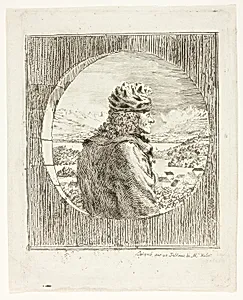
Medium
Etching on ivory laid paper
Dimensions
Plate: 21.2 × 16 cm (8 3/8 × 6 5/16 in.); Sheet: 22 × 17.8 cm (8 11/16 × 7 1/16 in.)
Classification
etching
Department
Prints and Drawings
Museum
Art Institute of Chicago
Accession Number
140639
Rights
Public Domain
About this artwork
Seen here is the famous French Enlightenment philosopher, poet, playwright, satirist, and historian known as Voltaire (1694–1778), born François-Marie Arouet. The conscience of his age, Voltaire remains relevant today; in the wake of the 2015 Charlie Hebdo shootings, his Treatise on Tolerance was brandished in Parisian rallies, leading the publisher Gallimard to reprint the volume in an edition of 10,000 copies.
Art Historical Context
"Voltaire Seen in Profile" is a captivating etching by Swiss artist Jean Huber, a close friend and neighbor of the Enlightenment philosopher Voltaire in Ferney, France. Created around the late 18th century (date unknown), this intimate portrait captures the iconic thinker in a sharp profile view, emphasizing his aquiline nose and thoughtful expression. Huber, renowned for his prolific series of over 200 images of Voltaire—ranging from reverent portraits to playful caricatures—produced this work as part of his unique documentation of the philosophe's life, blending admiration with gentle satire. Rendered as an etching on luxurious ivory laid paper, the print showcases Huber's mastery of the intaglio technique, where acid etches fine lines into a metal plate for rich, tonal depth and expressive detail. The modest plate size (21.2 × 16 cm) made it ideal for collectors and dissemination during the Enlightenment, when prints democratized access to celebrity likenesses. Housed in the Art Institute of Chicago's Prints and Drawings department, it exemplifies how etching preserved the visages of intellectual giants for posterity. This artwork holds cultural weight as a window into 18th-century intellectual circles, immortalizing Voltaire's sharp wit and influence on reason, liberty, and reform. Visitors will appreciate its historical charm, a testament to the personal bonds that fueled artistic legacy.