
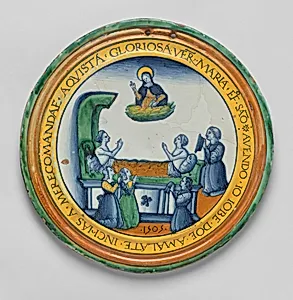
Votive plaque
Medium
tin-glazed earthenware (maiolica)
Dimensions
overall (height by diameter): 1.8 × 34.7 cm (11/16 × 13 11/16 in.)
Classification
Decorative Art
Department
CSD
Museum
National Gallery of Art, Washington, D.C.
Credit
Corcoran Collection (William A. Clark Collection)
Accession Number
2014.136.331
Rights
Public Domain
Art Historical Context
This exquisite *Votive plaque* from Deruta, Italy, dated 1505, exemplifies early Renaissance mastery of maiolica—tin-glazed earthenware that revolutionized ceramic art. Crafted in the vibrant workshops of Deruta, a Umbrian center renowned for its pottery since the 14th century, the plaque measures a modest 1.8 × 34.7 cm, suggesting it was designed to be affixed to a church wall or shrine. The tin glaze provided a smooth, opaque white ground ideal for bold colors and intricate designs, transforming everyday earthenware into luminous, jewel-like objects prized across Europe. Votive plaques like this were deeply rooted in Italian Catholic devotion, offered as ex-votos in gratitude for divine intercession—healings, safe births, or protection from peril. Hung en masse in sanctuaries, they formed colorful tapestries of faith, blending artistry with personal piety. Deruta's 16th-century potters elevated the form with refined techniques, firing the tin-opacified glaze at low temperatures to achieve its signature sheen, influencing maiolica's spread to tableware, tiles, and pharmacy jars. Now part of the National Gallery of Art's Corcoran Collection (William A. Clark Collection), this piece invites us to ponder the intimate intersections of art, spirituality, and craftsmanship in Renaissance Italy—a tiny testament to lives touched by hope and miracle.