
Votive stela of Userhat
Unknown Artist
1327–1295 BC
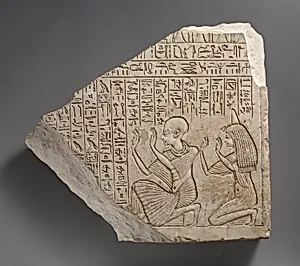
Medium
Limestone, paint
Dimensions
H. 42.5 cm (16 3/4 in); w. 48 cm (18 7/8 in)
Classification
Stela, Userhat
Period
New Kingdom
Department
Egyptian Art
Museum
Metropolitan Museum of Art, New York, NY
Credit
Gift of Egypt Exploration Fund, 1905
Accession Number
05.4.2
Rights
Public Domain
Tags
Art Historical Context
This votive stela from Egypt’s New Kingdom, late Dynasty 18 (1327–1295 BC), was dedicated by a man named Userhat as an offering of devotion. Such limestone monuments were placed in temples so the donor could perpetually honor the gods through depicted rituals and prayers. Painted scenes of men and women, accompanied by hieroglyphs, follow the era’s conventions of profile figures and symbolic composition. The work measures 42.5 cm high by 48 cm wide and was originally brightly colored, a standard technique that brought relief carvings to life. Hieroglyphic texts would have named the figures and recorded offerings, underscoring writing’s vital role in securing divine favor. Anonymous craftsmen, typical for functional religious art, combined sculpture and painting with remarkable skill. Gifted to the Metropolitan Museum of Art by the Egypt Exploration Fund in 1905, the stela offers a vivid window into everyday piety during a period of cultural restoration after the Amarna interlude. It reminds us how ordinary Egyptians used art to connect the living world with the eternal.