
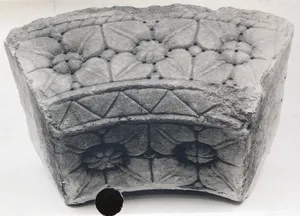
Voussoir
Unknown Artist
ca. 1130–40
Medium
Marble
Dimensions
Overall: 6 5/8 x 14 1/2 in. (16.8 x 36.8 cm)
Classification
Sculpture-Architectural
Culture
Catalan
Department
The Cloisters
Museum
Metropolitan Museum of Art, New York, NY
Credit
The Cloisters Collection, 1925
Accession Number
25.120.592
Rights
Public Domain
Tags
Art Historical Context
Nestled in The Cloisters collection at the Metropolitan Museum of Art this marble voussoir hails from Catalonia around 1130–40, a prime era of Romanesque architecture. A voussoir is a precisely wedge-shaped stone block essential to constructing graceful arches in medieval doorways, windows, and vaults. Measuring just 6⅝ × 14½ inches, this compact yet robust piece once formed part of a larger architectural ensemble, likely in a church or monastery, showcasing the era's masterful stonework. Crafted from marble, the voussoir exemplifies Catalan Romanesque sculpture's blend of structural ingenuity and subtle decoration. Artisans carved these blocks with exacting precision to interlock seamlessly under immense pressure, distributing weight evenly—a testament to medieval engineering prowess without modern tools. Its smooth surfaces and modest scale hint at both functionality and artistry, common in the region's pilgrimage routes where grand cathedrals drew the faithful. Today, this artifact transports visitors to 12th-century Catalonia, illuminating how architecture intertwined with spirituality and community. As part of The Cloisters' 1925 founding collection, it invites us to ponder the anonymous hands that shaped enduring stone into symbols of faith and permanence.