
Vrede te Passarowitz
Medium
striking (metalworking)
Dimensions
7.2; 3.2
Rights
Public Domain
About this artwork
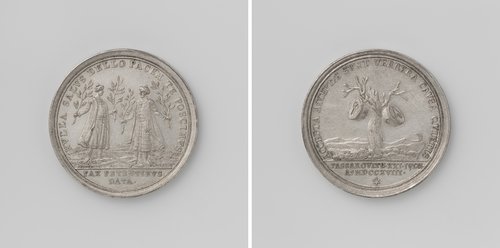
Zilveren penning. Voorzijde: twee Turken ieder met olijftak in elk van beide handen, terwijl hun zwaarden op grond liggen binnen omschrift; afsnede: opschrift. Keerzijde: twee ingeslagen keteltrommen hangend aan een afgebroken boomstam binnen omschrift; afsnede: opschrift
Art Historical Context
This silver medal, struck in 1718 by German medallist Georg Wilhelm Vestner, commemorates the Peace of Passarowitz that concluded the Austro-Turkish War. Measuring just 3.2 cm across and weighing 7.2 grams, the piece served as a portable record of diplomacy, widely distributed to mark the treaty signed between the Habsburg Empire and the Ottoman Empire. Vestner, working in the Baroque tradition of Nuremberg medalists, used the intimate scale of struck metalwork to translate grand political events into objects that could be held and examined. On the obverse, two Turkish figures extend olive branches in both hands while their swords rest on the ground, vividly symbolizing the laying down of arms. The reverse shows kettledrums suspended from a broken tree trunk, a poignant emblem of silenced military power. These carefully chosen images blend classical allegory with contemporary reportage, transforming a diplomatic agreement into a lasting visual statement. Such medals functioned as both souvenirs and propaganda, allowing contemporaries to carry a tangible reminder of Europe’s shifting borders. Vestner’s crisp striking technique ensures the details remain legible centuries later, inviting today’s viewers to reflect on how art once shaped public memory of peace.
About the Artist
Georg Wilhelm Vestner · 1677–1740
German, Schweinfurth 1677–1740 Nuremberg