
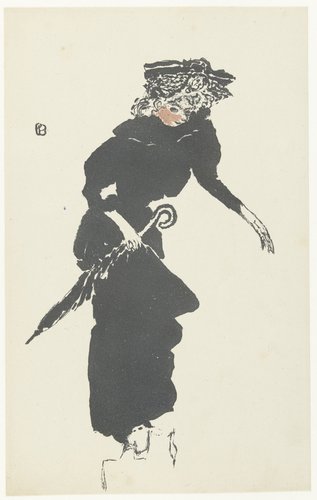
Vrouw met paraplu
1894
Medium
color printing
Dimensions
135; 220
Rights
Public Domain
About this artwork
beeld: hoogte 220 mm x breedte 135 mm
Art Historical Context
**Vrouw met Paraplu (Woman with Umbrella)**Pierre Bonnard, 1894 Color printing; 220 × 135 mm Created in 1894, *Vrouw met Parap* (Dutch for "Woman with Um") is an early color print by French artist Pierre Bonnard, a key figure in the Post-Impressionist group Les Nabis. At just 22 years old, Bonnard was experimenting with innovative printmaking techniques inspired by Japanese ukiyo-e woodblocks and the bold colors of Gauguin. This intimate-scale work—measuring a compact 220 mm high by 135 mm wide—captures the everyday charm of a woman shielding herself with an umbrella, rendered in vibrant, flattened hues typical of the Nabis' decorative style. Bonnard's use of color printing, likely lithography, marked a breakthrough in affordable, mass-reproducible art. Unlike traditional painting, this medium allowed him to layer translucent colors directly onto stone plates, achieving luminous effects with minimal lines. It reflected the era's fascination with modern life and posters, bridging fine art and popular culture in fin-de-siècle Paris. This charming print offers a glimpse into Bonnard's evolving vision, foreshadowing his lifelong pursuit of intimate domestic scenes bathed in light and color. A delightful pocket-sized gem, it invites visitors to appreciate how everyday moments could inspire artistic innovation.
About the Artist
Pierre Bonnard · 1867–1947
Pierre Bonnard (1867–1947) was a French painter and printmaker who became a leading figure in the Post-Impressionist movement and a founding member of Les Nabis. Born on October 3, 1867, in Fontenay-aux-Roses, France, Bonnard initially studied law at his father's insistence, graduating and briefly practicing as a barrister in 1888. However, his true passion lay in art, and he had simultaneously at...