
Vue d’Église et Entrée du Village d’Essômes
1880
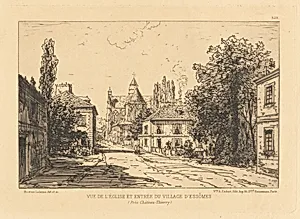
Medium
etching on chine collé on laid paper
Dimensions
image: 11.7 × 18.4 cm (4 5/8 × 7 1/4 in.) plate: 14.7 × 20.8 cm (5 13/16 × 8 3/16 in.) sheet: 31.5 × 48.2 cm (12 3/8 × 19 in.)
Classification
Department
CG-E
Museum
National Gallery of Art, Washington, D.C.
Credit
Gift of Carol and James Goodfriend
Accession Number
2021.113.54
Rights
Public Domain
Art Historical Context
Maxime Lalanne’s *Vue d’Église etée du Village d’ômes* (View of the Church and Entrance the Village of Essômes created in 1880, a serene rural scene from the French village of Essômes-sur-Marne. As a prominent 19th-century French etcher and painter (1827–1886), Lalanne specialized in detailed landscapes and architectural views, often evoking the quiet charm of provincial life. This print reflects the era’s fascination with everyday French countryside motifs, bridging Romantic traditions with the rising interest in natural light and texture during the late Impressionist period. The work is an etching on chine collé applied to laid paper, a refined technique where a delicate sheet of thin Chinese paper is adhered to a sturdier support during printing. This method, popular among 19th-century printmakers, allowed for intricate line work and subtle tonal variations while ensuring durability—ideal for Lalanne’s precise rendering of stone church facades, winding village paths, and atmospheric depth. The modest image size (11.7 × 18.4 cm) invites intimate viewing, highlighting the etching’s fine burr and plate tone. Now in the National Gallery of Art’s collection (gift of Carol and James Goodfriend), this piece exemplifies the etching revival in France, showcasing Lalanne’s mastery in translating three-dimensional scenes into luminous, textured prints that celebrate cultural heritage and the beauty of overlooked locales.
About the Artist
Maxime Lalanne · 1827–1886
François Antoine Maxime Lalanne (1827–1886) was born in Bordeaux into a family of civil servants, initially pursuing classical studies and a law career. At the Institution Oré, he learned drawing from instructor Saulnier and showed early promise, exhibiting pencil and pastel works at Bordeaux's Philomathique Society in 1850, where he earned a bronze medal. Encouraged by architect Léo Drouyn, Lalan...