
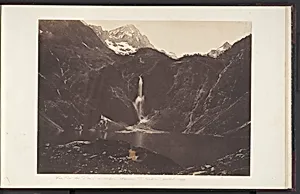
Vue du lac d'Oo ou Seculejo, Bagnère de Luchon
1853
Medium
Salted paper print from paper negative
Dimensions
Image: 10 1/8 × 14 1/16 in. (25.7 × 35.7 cm) Sheet: 12 in. × 18 9/16 in. (30.5 × 47.2 cm)
Classification
Photographs
Department
Photographs
Museum
Metropolitan Museum of Art, New York, NY
Credit
Gilman Collection, Gift of The Howard Gilman Foundation, 2005
Accession Number
2005.100.503.23
Rights
Public Domain
Tags
Art Historical Context
Step into the breathtaking French Pyrenees with Joseph Vigier's *Vue du lac d'Oo ou Seculejo,ère de Luchon* (1853), a paper print from a paper that masterfully captures a serene lake nestled amid cascading waterfalls and towering mountains. This 10⅛ × 14¹/₁₆-inch image transports viewers to the remote Lac d'Oo near Bagnères-de-Luch, a picturesque spa town, evoking the wild grandeur of 19th-century European landscapes. Vigier, a French photographer active in the 1850s, employed the calotype process—pioneered by William Henry Fox Talbot—which used a paper negative to produce richly toned positives. Unlike the sharp, one-of-a-kind daguerreotypes, this technique allowed for subtle gradations of light and shadow, ideal for rendering the misty veils of waterfalls and the rugged contours of alpine peaks. Created just a decade after photography's public debut, the work highlights early photographers' daring expeditions to document untamed nature. Housed in the Metropolitan Museum of Art's Gilman Collection, this print celebrates the dawn of landscape photography, blending technical innovation with romantic awe for the sublime. It's a window to a pristine world, reminding us how 1850s artists like Vigier forever preserved fleeting natural wonders.