
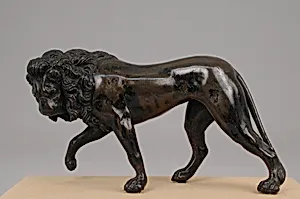
Walking Lion
early 17th century
Medium
Bronze
Dimensions
Overall (confirmed): 4 1/2 × 7 5/8 × 2 1/4 in. (11.4 × 19.4 × 5.7 cm)
Classification
Sculpture-Bronze
Culture
French, Paris
Department
European Sculpture and Decorative Arts
Museum
Metropolitan Museum of Art, New York, NY
Credit
The Friedsam Collection, Bequest of Michael Friedsam, 1931
Accession Number
32.100.164
Rights
Public Domain
Tags
Art Historical Context
Behold the majestic *Walking Lion*, a bronze sculpture crafted by Barthélemy Prieur early 17th-century Paris. Measuring just 4½ × 7⅝ × 2¼ inches, this diminutive yet dynamic figure captures a lion in mid-stride, its muscular form poised with elegant tension. Prieur, a leading French sculptor who served the royal court under Henry IV and Louis XIII, the transition from Mannerism to early Baroque in his refined modeling and lifelike anatomy. Bronze was a prized medium for such works, allowing for intricate lost-wax casting techniques that produced smooth, patinated surfaces ideal for both display and integration into furniture or decorative ensembles. Lions, symbols of strength and nobility, held cultural resonance in French aristocratic circles, evoking power and exotic grandeur amid the opulence of the Grand Siècle's precursors. Part of The Friedsam Collection at The Metropolitan Museum of Art's Department of European Sculpture and Decorative Arts, this piece invites visitors to ponder the artistry of animal representation in royal patronage, where every sinew and stride tells a story of mastery and majesty.
About the Artist
Barthélemy Prieur · 1536–1611
French, Berzieux ca. 1536–1611 Paris