
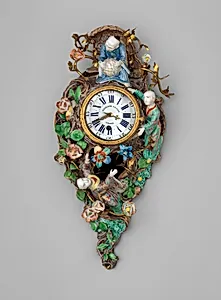
Wall clock (cartel)
ca. 1735–40
Medium
Case: soft-paste porcelain and partly gilded brass; Dial: white enamel; Movement: brass and steel
Dimensions
Overall: 19 1/2 × 9 1/2 × 4 3/4 in. (49.5 × 24.1 × 12.1 cm); Diameter (back plate): 3 3/8 in. (8.6 cm)
Classification
Horology
Culture
French, Paris with French, Chantilly case
Department
European Sculpture and Decorative Arts
Museum
Metropolitan Museum of Art, New York, NY
Credit
The Jack and Belle Linsky Collection, 1982
Accession Number
1982.60.84
Rights
Public Domain
Tags
Art Historical Context
This exquisite wall clock, or *cartel*, crafted around 1735–40 by Parisian clockmaker Etienne LeNo with a case from the renowned Chantilly porcelain factory, exemplifies the opulence of French Rococo decorative arts during the Louis XV era. Measuring nearly 20 inches tall, its soft-paste porcelain case—delicately painted and adorned with gilded brass elements—features motifs of globes, men, and flowers, evoking a asymmetry and natural exuberance characteristic of the style. The white enamel dial and intricate brass-and-steel movement highlight the era's mastery in horology, where timepieces were not mere functional objects but lavish status symbols for aristocratic interiors. Chantilly's soft-paste porcelain, a French innovation mimicking translucent Chinese wares, was prized for its fine detail and affordability compared to true porcelain, allowing artists to sculpt whimsical figures and floral garlands. Gilding added a shimmering luxury, reflecting the period's fascination with *chinoiseries* and ornate *objets de vertu*. Part of The Jack and Belle Linsky Collection at The Metropolitan Museum of Art, this clock underscores Paris's dominance in 18th-century luxury crafts, blending technical precision with artistic fantasy to charm and impress.
About the Artist
Etienne LeNoir|Chantilly (French|French) · 1675 | –1739 |
French, 1675–1739|French