
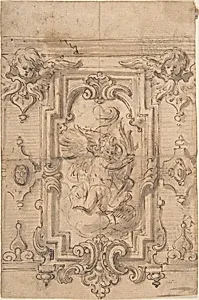
Wall Design with Flying Putto
Medium
Pen and brown ink, brush and brown wash
Dimensions
sheet: 7 7/8 x 5 1/4 in. (20 x 13.3 cm)
Classification
Drawings
Department
Drawings and Prints
Museum
Metropolitan Museum of Art, New York, NY
Credit
Gift of Henry Walters, 1917
Accession Number
17.37.305
Rights
Public Domain
Tags
Art Historical Context
This delicate drawing, *Wall Design with Flying Put*, captures the whimsical spirit of 17th- or 18th-century ornamental art. Created anonymously by an Italian artist using pen and brown ink for precise lines, enhanced by brush and brown wash for subtle shading, it depicts a cherubic putto soaring amid decorative motifs. Measuring just 7 7/8 x 5 1/4 inches, this preparatory sketch likely served as a design for lavish wall decorations in palaces or churches, evoking the grandeur of Italy's Baroque and Rococo eras. Putti—playful, winged infants symbolizing love, joy, and divine playfulness—were staples of European decorative arts, drawing from Renaissance precedents like Raphael's frescoes. Here, the flying putto embodies the exuberant, dynamic ornamentation that adorned opulent interiors, blending architecture with illusionistic painting. Such drawings were essential tools for artists and architects, allowing experimentation before committing to fresco or stucco. Housed in the Metropolitan Museum of Art's Drawings and Prints department as a gift from Henry Walters in 1917, this work highlights the technical mastery of ink and wash techniques, which provided depth and movement on a small scale. Visitors can appreciate how these humble sketches fueled the splendor of Italy's artistic legacy.