
Wall light (candelabrum appliqué) (one of a pair)
Unknown Artist
ca. 1735
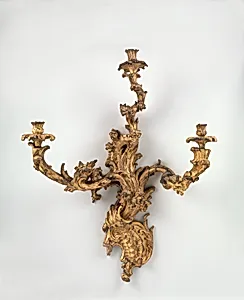
Medium
Carved and gilded walnut
Dimensions
Overall: 36 × 32 3/4 × 12 1/2 in. (91.4 × 83.2 × 31.8 cm)
Classification
Woodwork-Furniture
Culture
French
Department
European Sculpture and Decorative Arts
Museum
Metropolitan Museum of Art, New York, NY
Credit
Gift of J. Pierpont Morgan, 1906
Accession Number
07.225.412a
Rights
Public Domain
Art Historical Context
This elegant wall light, or candelabrum appliqué dates to around 1735 and exemplifies the opulent decorative arts of Louis XV-era France. One of a pair, it have adorned the walls of a grand salon or château, holding flickering candles to illuminate lavish interiors. Crafted during the early Rococo period, such fixtures shifted from the heavy drama of Baroque toward lighter, more playful designs, often featuring scrolling motifs inspired by nature and shellwork—though the precise ornament here remains a testament to anonymous mastery. Carved from walnut and lavishly gilded, the piece showcases virtuoso woodworking techniques. Walnut's fine grain allowed for intricate detailing, while gilding with gold leaf added a shimmering luxury befitting aristocratic homes. Measuring an impressive 36 by 32¾ inches, its scale suited palatial spaces, blending functionality with high artistry in the European tradition of ébénisterie (cabinetmaking). A gift to the Metropolitan Museum of Art from J. Pierpont Morgan in 1906, this survivor of French opulence invites us to imagine the candlelit soirées of the Ancien Régime, where light and shadow danced across gilded splendor.