
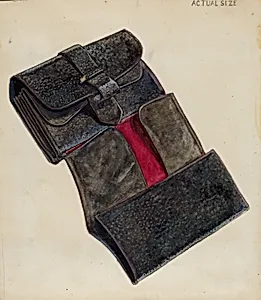
Wallet
c. 1936
Medium
watercolor, graphite, and gouache on paper
Dimensions
overall: 21 x 23.9 cm (8 1/4 x 9 7/16 in.) Original IAD Object: 6" high; 7 1/2" wide; 1 3/4" thick
Classification
Index of American Design
Department
CG-W
Museum
National Gallery of Art, Washington, D.C.
Credit
Index of American Design
Accession Number
1943.8.2174
Rights
Public Domain
Art Historical Context
This delicate rendering of a wallet by Thomas Holloway captures the humble yet intricate craftsmanship of early American leatherwork. Created around 1936 as part of the Index of American Design, a federal project under the Works Progress Administration, the watercolor documents everyday objects from the nation’s past. The original wallet, measuring just six inches high and seven-and-a-half inches wide, likely dates to the nineteenth century and reflects the practical artistry of anonymous makers who combined utility with decorative detail. Holloway employed watercolor, graphite, and gouache on paper to achieve both precision and subtle texture, techniques well suited to the Index’s goal of faithful reproduction. These layered media allow the fine grain of the leather, the stitching, and any embossed patterns to emerge with clarity, preserving details that might otherwise fade from memory. Such works served as both artistic records and educational tools during the Great Depression, celebrating American material culture at a time when national identity felt especially vital. Today, this piece in the National Gallery of Art’s collection reminds viewers that even the smallest personal objects can embody broader stories of trade, craftsmanship, and daily life in the United States.