
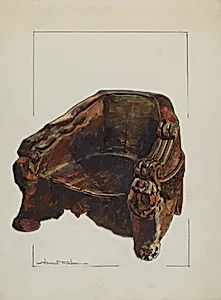
Walnut Chair
c. 1937
Medium
watercolor, colored pencil, gouache, and graphite on paper
Dimensions
overall: 31.1 x 23.2 cm (12 1/4 x 9 1/8 in.) Original IAD Object: 28"high; 31"wide at base
Classification
Index of American Design
Department
CG-W
Museum
National Gallery of Art, Washington, D.C.
Credit
Index of American Design
Accession Number
1943.8.4456
Rights
Public Domain
Art Historical Context
Behold the *Walnut Chair*, a rendering by artist Florence Truelson, created around 1937. This vibrant watercolor, colored pencil, gouache and graphite work on paper (31.1 x 23.2 cm) captures elegant curves and rich grain of an original walnut chair measuring 28 inches high and31 inches wide at the. Truelson's precise draftsmanship highlights the chair's graceful proportions, from its cabriole legs to its intricately carved crest rail, evoking the refined craftsmanship of early American furniture. As part of the Index of American Design—a groundbreaking WPA Federal Art Project from the 1930s—this piece served a vital cultural mission. During the Great Depression, artists like Truelson documented everyday American objects, from folk art to high-style furnishings, to celebrate national heritage and inspire pride in indigenous design traditions. Housed in the National Gallery of Art's collection, it preserves the walnut chair's tactile beauty through layered media: gouache for depth, watercolor for subtle tones, and graphite for fine details. Truelson's technique not only records form and texture but also infuses the ordinary with artistic vitality, bridging utilitarian craft and fine art. A testament to American ingenuity, this work invites us to appreciate how everyday objects embody history's quiet elegance.
About the Artist
Florence Truelson · 1901–1959
Florence Truelson is an artist whose biographical details remain largely undocumented in the major art historical sources. No confirmed dates of birth or death have been established, and her nationality, training, and primary working period are not reliably recorded in available scholarship. Works attributed to Truelson suggest a practiced hand and an awareness of the artistic conventions of her ...