
Walter Hasenclever
1917
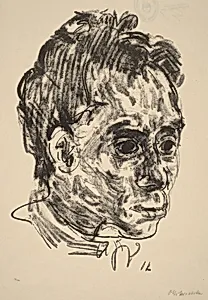
Medium
lithograph
Classification
Department
CG-W
Museum
National Gallery of Art, Washington, D.C.
Credit
Rosenwald Collection
Accession Number
1951.10.329
Rights
Public Domain
Art Historical Context
Created in 1917 during the height of World War I, Oskar Kokoschka’s lithograph portrait of Walter Hasenclever captures the intense spirit of early 20th-century Expressionism. Kokoschka, an Austrian artist renowned for his psychologically charged portraits, often used bold lines and expressive distortions to reveal the inner life of his subjects. Here, the medium of lithography allows these dynamic qualities to reach a broader audience through print, making the work both intimate and widely accessible. Walter Hasenclever, a German expressionist poet and playwright, was part of the same vibrant cultural circles that Kokoschka moved in. The portrait reflects the turbulent era in which both men lived, marked by artistic innovation amid global conflict. As part of the National Gallery of Art’s Rosenwald Collection, this print highlights how lithography served as a vital tool for preserving and sharing powerful images of modern creative figures.
About the Artist
Oskar Kokoschka · 1886–1980
Oskar Kokoschka (1886–1980) was an Austrian painter, graphic artist, and writer who became one of the foremost Expressionist artists of the twentieth century. Born in Pöchlarn, Austria, he studied at the Vienna School of Arts and Crafts, where he was influenced by Gustav Klimt and the Vienna Secession. His early works — including his play "Murderer, the Hope of Women" (1909) and his disturbing psy...