
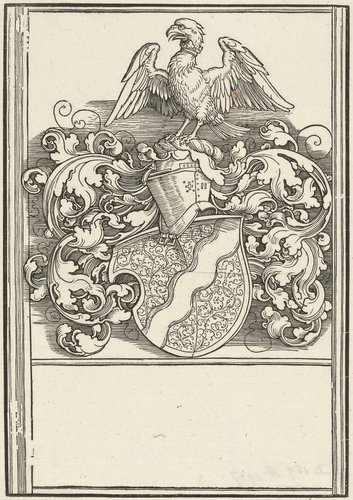
Wapen van Michael Behaim
1585 - 1595
Medium
paper
Dimensions
278; 194
Rights
Public Domain
About this artwork
beeld: hoogte 278 mm x breedte 194 mm
Art Historical Context
**Coat of Arms of Michaelhaim** by Albrecht Dürer invites visitors into the meticulous world of Renaissance heraldry. Created between 1585 and 1595 on paper, this compact work measures 278 mm high by 194 mm wide, embodying the precision of Dürer's Northern Renaissance style. Though Dürer, the famed German artist and printmaker from Nuremberg (1471–8), is best known for his intricate engravings and woodcuts *Melencolia I*, this piece reflects his mastery in capturing symbolic emblems with fine lines and balanced composition. As a coat of arms—or *wapen* in Dutch—the artwork commemorates Michael Behaim, a member of a prominent Nuremberg patrician family linked to explorer Martin Behaim, creator of the early globe Erdapfel. Heraldic designs like this were vital status symbols in 16th-century Europe, adorning manuscripts, seals, and homes to signify lineage and prestige. Rendered on paper, a medium Dürer championed for its affordability and reproducibility, it highlights his innovative techniques in detailed rendering, making elite iconography accessible. This modest yet elegant piece underscores Dürer's enduring influence on graphic arts, blending artistry with cultural identity. Gaze closely to appreciate the subtle interplay of form and symbolism in this heraldic treasure.
About the Artist
Albrecht Dürer · 1471–1528
Albrecht Dürer (1471–1528) stands as the preeminent figure of the Northern Renaissance and arguably the most influential artist in the history of printmaking. Born in Nuremberg on May 21, 1471, and dying in the same city on April 6, 1528, Dürer revolutionized the status of the artist in Northern Europe, transforming printmaking from a commercial craft into an independent fine art and establishing ...