
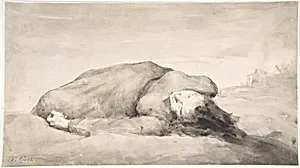
War Scene (A Female Casualty)
ca. 1870–72
Medium
Pen and black ink, brush and gray wash, with touches of red ink on heavy off-white wove paper
Dimensions
7 13/16 x 13 3/4 in. (19.8 x 35cm)
Classification
Drawings
Department
Drawings and Prints
Museum
Metropolitan Museum of Art, New York, NY
Credit
Purchase, Bequest of Helen Hay Whitney, by exchange, and Clifford A. Furst Bequest, by exchange, 1994
Accession Number
1994.228
Rights
Public Domain
Tags
Art Historical Context
In the stark drawing *War Scene (A Female Casualty)*, created by French artist Théodule-Augustin Ribot around 1870–72, a tragic moment unfolds amid conflict. Rendered on heavy off-white wove paper, this intimate sheet (7 13/16 x 13 3/4 in.) captures the grim reality of war through a fallen female figure, evoking the human cost of battle. Ribot, a Realist painter known for his unflinching depictions of everyday life and influenced by 17th-century Spanish masters like Ribera, here turns his hand to a poignant genre scene, highlighting vulnerability in wartime chaos. The timing aligns with the Franco-Prussian War (1870–71), a devastating conflict that ravaged France, leading to the fall of Napoleon III and the bloody Paris Commune. Ribot's focus on a female casualty—uncommon in male-dominated war imagery—underscores the war's indiscriminate toll on civilians, adding emotional depth and cultural resonance to this work from The Metropolitan Museum of Art's Drawings and Prints department. Artistically, Ribot employs pen and black ink for precise lines, brush and gray wash for moody shadows, and subtle red ink accents—likely evoking blood—to heighten drama. This mixed-media technique, ideal for rapid yet evocative sketches, showcases the power of drawing to convey horror and pathos, inviting viewers to reflect on war's enduring scars.