
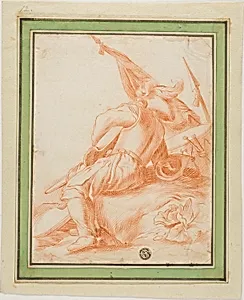
Warrior at Rest
n.d.
Medium
Red chalk, on ivory laid paper, tipped on ivory laid paper, tipped on pale green laid paper
Dimensions
19.5 × 15.2 cm (7 11/16 × 6 in.)
Classification
chalk
Department
Prints and Drawings
Museum
Art Institute of Chicago
Accession Number
85241
Rights
Public Domain
Art Historical Context
Salvator Rosa's *Warrior at Rest* (n.d.) is a captivating drawing from the 17th-century Italian Baroque master, housed in the Art Institute of Chicago's Prints Drawings Department. Rendered in red chalk on ivory laid paper—then meticulously tipped onto additional sheets of ivory and pale green laid paper—this intimate 19.5 × 15.2 cm study exemplifies Rosa's prowess in figure drawing. The multi-layered support suggests careful preservation of a delicate work, typical for such sketches. Rosa, a Neapolitan artist (1615–1673) influenced by Caravaggio's dramatic tenebrism, often depicted rugged warriors, bandits, and classical heroes with expressive energy and psychological depth. This resting warrior, with its fluid lines and subtle modeling, captures a moment of quiet vulnerability amid implied turmoil, reflecting Baroque interests in human emotion and heroism. Red chalk, prized for its warm, sanguine tones, allowed Rosa to achieve lifelike flesh and shadow, a technique he mastered in hundreds of surviving sheets. As a chalk drawing, it highlights Rosa's versatility beyond painting and etching, offering museum visitors a window into an artist's studio process. Its small scale invites close contemplation, revealing the raw vitality that defined his rebellious spirit and bridged Baroque drama with emerging Romanticism.
About the Artist
Salvator Rosa · 1615–1673
Salvator Rosa was born in 1615 in Arenella, on the outskirts of Naples, into a world of artistic ambition and turbulent talent. His early training came through his maternal uncle, the painter Paolo Greco, and his brother-in-law Francesco Fracanzano, himself a pupil of the great Spanish-born Neapolitan master Jusepe de Ribera. Rosa showed a fierce independence from the start, resisting his father's...