
Washington Monument
1846
Medium
Tint lithograph on ivory wove paper
Dimensions
Image: 61.7 × 44.1 cm (24 5/16 × 17 3/8 in.); Sheet: 73 × 52.6 cm (28 3/4 × 20 3/4 in.)
Classification
lithograph
Department
Prints and Drawings
Museum
Art Institute of Chicago
Accession Number
129457
Rights
Public Domain
Art Historical Context
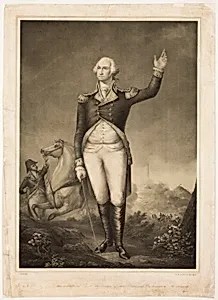
Behold the striking *Washington Monument*, a tint lithograph created in 1846 by Augusten, a prominent Baltimore-based lithographer of German origin. Printed on fine ivory wove paper, image measures 61.7 44.1 cm, capturing the monument during its construction—a towering obelisk honoring George Washington, the father of the nation. Housed in the Art Institute of Chicago's and Drawings department, it exemplifies mid-19th-century printmaking at its finest. Lithography, perfected in the early 1800s, revolutionized image reproduction by allowing artists like Hoen to draw directly on stone for precise, detailed transfers to paper. The "tint" technique introduced subtle hand-applied or stone-printed colors, bringing vibrancy to what might otherwise be a stark architectural rendering. Hoen's firm, A. Hoen & Co., specialized in such views of American landmarks, making grand scenes accessible to the public through affordable prints. This artwork holds cultural weight as a snapshot of American patriotism in the antebellum era. The Baltimore Washington Monument, begun in 1815 and nearing completion by 1846, symbolized civic pride and national unity amid rapid urbanization. Visitors today can appreciate how Hoen's skilled composition blends technical innovation with historical reverence, inviting us to reflect on the enduring legacy of Washington's ideals.