
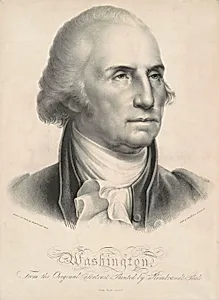
Washington
Rembrandt Peale, 1832-1833
About this artwork
Rembrandt Peale's *Washington* (18321833) is a striking lithograph portrait of George Washington, capturing the first president's dignified profile in a style reminiscent of classical Roman busts. Peale, an acclaimed American painter and son of portraitist Charles Willson Peale, devoted much of his career to immortalizing Washington, refining his iconic image over decades. This print reproduces elements of his earlier oil painting *Patriae Pater* (1823), emphasizing Washington's stoic gaze and powdered wig to evoke enduring patriotism. Printed in black ink on wove paper—a smooth, durable support ideal for fine detail—lithography allowed Peale to mass-produce this image affordably. The medium, pioneered in the late 18th century, relied on the artist's greasy crayon drawing repelled by water, enabling precise tonal gradations and widespread dissemination. At roughly 40 × 37 cm, the irregular image fits neatly on a larger sheet, making it accessible for homes and public spaces. Created amid the 1832 centennial of Washington's birth, this lithograph fueled national reverence for the Founding Father during a time of growing American identity. Part of the Corcoran Collection at the National Gallery of Art, it exemplifies 19th-century print culture's role in shaping heroes and history.