
Watch
Unknown Artist
early 17th century
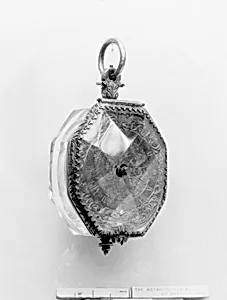
Medium
Rock crystal, gold
Dimensions
2 3/4 × 1 1/2 in. (7 × 3.8 cm)
Classification
Horology
Culture
German
Department
European Sculpture and Decorative Arts
Museum
Metropolitan Museum of Art, New York, NY
Credit
Gift of Professor Brander Matthews, 1924
Accession Number
24.104.1
Rights
Public Domain
Art Historical Context
This exquisite early 17th-century pocket watch exemplifies the pinnacle of horological craftsmanship during the Renaissance era. Crafted from translucent rock crystal—a prized material for its clarity and durability—and gleaming gold, it measures a mere 2¾ × 1½ inches, designed to be worn on a chain or tucked into a pocket. Its compact form reflects the technological leap from cumbersome clocks to portable timepieces, which became coveted status symbols among Europe's nobility. Rock crystal cases allowed owners to peer inside and admire the intricate mechanical movement, blending scientific ingenuity with artistic virtuosity. German watchmakers, centered in regions like Augsburg, were renowned for such innovations, pushing the boundaries of miniaturization and precision gearing. The gold components, likely engraved or chased, added opulence, turning the watch into a wearable jewel. Today, housed in the Metropolitan Museum of Art's European Sculpture and Decorative Arts department (gift of Professor Brander Matthews, 1924), this anonymous masterpiece highlights how timekeeping evolved into high art, merging utility with luxury in an age of exploration and discovery. Visitors can't help but marvel at its delicate beauty—a tiny universe of gears frozen in crystal.