
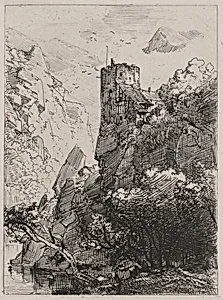
Watchtower on a Cliff with a Stream
Medium
etching
Dimensions
sheet: 22.2 x 30.9 cm (8 3/4 x 12 3/16 in.) plate: 10.5 x 8 cm (4 1/8 x 3 1/8 in.)
Classification
Department
CG-E
Museum
National Gallery of Art, Washington, D.C.
Credit
Ailsa Mellon Bruce Fund
Accession Number
2010.69.8.a
Rights
Public Domain
Art Historical Context
Caspar Johann Nepomukuren's *Watchtower on a Cliff with a* (1842) captures the dramatic essence of Romantic landscape art through the intimate medium of etching. A member of Germany's Düsseldorf school of painting, Scheuren specialized in evocative scenes of nature's sublime power, blending meticulous detail with emotional grandeur. This print, executed on a modest plate of just 10.5 x 8 cm, showcases the precision of etching—a technique where acid bites into a metal plate to create intricate lines, allowing for rich tonal contrasts and textures that evoke misty cliffs and rushing waters. The composition centers on a rugged watchtower perched precariously on a sheer cliff, overlooking a winding stream below, embodying Romantic ideals of isolation, peril, and the untamed wilderness. Produced during the height of 19th-century Romanticism, it reflects a cultural fascination with nature's majesty amid Europe's industrial stirrings, inviting viewers to contemplate humanity's fragile place in the vast landscape. Acquired through the Ailsa Mellon Bruce Fund for the National Gallery of Art's print collection (CG-E), this work highlights etching's role in democratizing art—affordable multiples that brought Scheuren's visions to wider audiences. At 22.2 x 30.9 cm on its sheet, it's a gem for close study, revealing the artist's masterful command of light and shadow in miniature form.