
Water Coupe
Unknown Artist
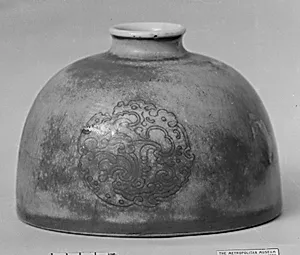
Medium
Porcelain with incised decoration under peachbloom glaze
Dimensions
H. 3 1/2 in. (8.9 cm); Diam. 5 in. (12.7 cm)
Classification
Ceramics
Culture & Period
China · Qing dynasty (1644–1911), Kangxi mark and period (1662–1722)
Department
Asian Art
Museum
Metropolitan Museum of Art, New York, NY
Credit
H. O. Havemeyer Collection, Bequest of Mrs. H. O. Havemeyer, 1929
Accession Number
29.100.336
Rights
Public Domain
Art Historical Context
This delicate **Water Coupe**, a small porcelain vessel from China's Qing dynasty during the Kangxi period (2–1722), the era's mastery of ceramic artistry. Bearing an authentic Kangxi reign mark, it measures just 3½ inches high and 5 inches diameter, perfect for practical yet elegant use—likely as a brush washer or water container on a scholar's desk Produced at the imperial kilns of Jingdezhen, Kangxi porcelains like this were celebrated worldwide for their technical perfection and subtle beauty. The coupe's standout feature is its peachbloom glaze, a soft, rosy hue evoking fresh peach blossoms, achieved through sophisticated copper-red flambé firing techniques. Beneath this luminous glaze, fine incised decoration—carved into the unfired clay—adds tactile depth and restrained elegance, a hallmark of Kangxi refinement. Peachbloom wares were highly prized by collectors for their rarity and naturalistic glow, bridging utility and connoisseurship in literati culture. Part of the renowned H. O. Havemeyer Collection and now housed in The Metropolitan Museum of Art's Asian Art Department, this piece invites us to appreciate the Qing dynasty's porcelain legacy: objects that fused innovation, imperial patronage, and timeless aesthetic harmony.