
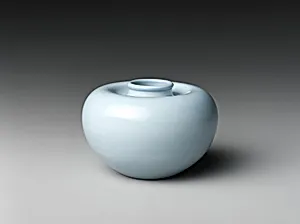
Water Jar
Unknown Artist
1689–1712
Medium
Porcelain with moonlight glaze (Jingdezhen ware)
Dimensions
H. 2 7/8 in. (7.3 cm); Diam. 4 1/8 in. (10.5 cm)
Classification
Ceramics
Culture & Period
China · Qing dynasty (1644–1911), Kangxi mark and period (1662–1722)
Department
Asian Art
Museum
Metropolitan Museum of Art, New York, NY
Credit
Gift of Edwin C. Vogel, 1966
Accession Number
66.206.4
Rights
Public Domain
Art Historical Context
This delicate water jar, crafted in Jingdezhen porcelain with a luminous moonlight glaze, exemplifies the pinnacle of Qing dynasty ceramics during the Kangxi period (1662–1722). Dated between 1689 and 1712 and bearing the Kangxi reign mark, it stands just 2⅞ inches tall with a 4⅛-inch diameter—perfectly sized for a scholar's desk, where it would hold water for grinding ink or rinsing brushes. Jingdezhen, China's imperial porcelain capital, produced wares like this for both courtly and elite use, showcasing technical mastery in firing and glazing. The moonlight glaze, a hallmark innovation of Kangxi-era kilns, creates a soft, ethereal glow resembling pale moonlight on snow, achieved through precise control of translucent layers over a fine white body. This subtle elegance reflects the period's aesthetic shift toward refined simplicity and natural beauty, moving beyond bold polychrome designs of earlier Ming wares. Such pieces were prized for their purity and harmony, symbolizing scholarly refinement in literati culture. Today, this jar—gifted to the Metropolitan Museum of Art in 1966—invites us to appreciate the Qing artisans' alchemy, blending utility with poetic artistry in everyday objects that transcended borders through global trade.