
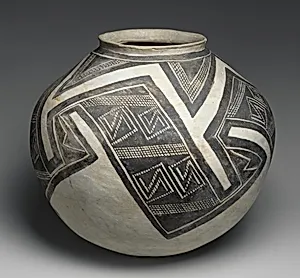
Water Jar (Olla)
Unknown Artist
13th–14th century
Medium
Clay
Dimensions
H. 12 3/4 × W. 15 1/4 × D. 14 1/16 in. (32.4 × 38.7 × 35.7 cm)
Classification
Ceramics-Vessels
Culture
Ancestral Puebloan (Kayenta Black-on-White)
Department
Arts of Africa, Oceania, and the Americas
Museum
Metropolitan Museum of Art, New York, NY
Credit
Gift of Samuel and Gabrielle Lurie, in celebration of the Museum's 150th Anniversary, 2019
Accession Number
2019.565.2
Rights
Public Domain
Art Historical Context
This elegant Water Jar, or *olla*, hails from the Ancestral Puebloan of the Kayenta region in the American Southwest, crafted between the 13th and 14th centuries. to the Kayenta Black-on-White ceramic, it exemplifies the sophisticated pottery of these prehistoric communities, who thrived in the arid landscapes of present-day Arizona and Utah. Ollas like this were vital for daily life, designed to store and transport water with their wide mouths, rounded bodies, and narrow necks that minimized evaporation and spillage in a harsh environment. Artistically, the jar showcases masterful hand-coiling techniques, where clay was built up in coils, scraped smooth, and coated with a white slip before intricate black mineral-paint designs were applied and fired at low temperatures in open pits. The Kayenta Black-on-White style features bold geometric motifs—often interlocking scrolls, feathers, or hatchures—symbolizing the Pueblos' deep connection to nature, agriculture, and cosmology. Standing at 12¾ inches tall, this vessel highlights the Ancestral Puebloans' engineering prowess and aesthetic refinement during a period of cultural flourishing before regional migrations around 1300 CE. A generous gift to the Metropolitan Museum of Art in 2019 from Samuel and Gabrielle Lurie, celebrating the museum's 150th anniversary, this olla invites us to appreciate the enduring legacy of Ancestral Puebloan ingenuity in the Department of Arts of Africa, Oceania, and the Americas.