
Water
1551 to 1600
Medium
etching
Classification
Department
CG-E
Museum
National Gallery of Art, Washington, D.C.
Credit
Rosenwald Collection
Accession Number
1943.3.8235
Rights
Public Domain
Art Historical Context
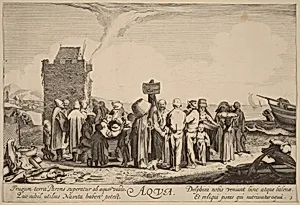
Behold *Water*, a delicate etching by Jan van de Velde II, created after a design by Willem Buytech. Dating to the late 16th early 17th centurycirca 1551–1600), this print captures the emerging spirit of the Dutch Golden Age, where artists like Buytewech pioneered elegant genre scenes and landscapes, and van de Velde excelled as a master reproductive engraver. Housed in the National Gallery Art's Rosenwald CollectionDepartment CG-E), it exemplifies the collaborative brilliance of Northern European printmaking. Etching, the medium here, revolutionized print production in the Renaissance. Van de Velde used acid to bite fine lines into a metal plate, allowing for intricate details and tonal subtlety that mimicked drawing—perfect for reproducing Buytewech's fluid compositions. This technique democratized art, making sophisticated imagery accessible beyond paintings, and reflects the era's fascination with everyday life and nature, possibly evoking serene waterways central to Dutch identity. As a testament to artistic homage, *Water* bridges two innovators: Buytewech's lively figural style and van de Velde's precise linework. Visitors will appreciate its historical role in spreading innovative designs across Europe, inviting us to ponder the ripples of influence in art history.