
Watermelon
mid 19th century
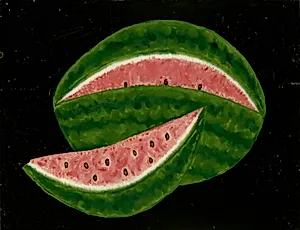
Medium
reverse painting on glass
Dimensions
overall: 35.5 x 45.7 cm (14 x 18 in.) framed: 39 x 49.5 cm (15 3/8 x 19 1/2 in.)
Classification
Painting
Department
CAB
Museum
National Gallery of Art, Washington, D.C.
Credit
Gift of Edgar William and Bernice Chrysler Garbisch
Accession Number
1964.23.6
Rights
Public Domain
Art Historical Context
This mid-19th-century painting, simply titled *Watermelon*, was created an anonymous American artist using the distinctive technique of reverse painting on. Measuring 14 by 18, the work is part of the National Gallery Art’s collection thanks to the generous gift of Edgar William andice Chrysler Garbisch noted collectors of American vernacular art. Reverse painting on glass requires the artist to apply pigments to the back of a glass pane so the finished image is viewed from the front. The result is a smooth, luminous surface that gives colors unusual clarity and depth. The method was widely practiced in 19th-century America for decorative still lifes and other household pictures, frequently by self-taught or itinerant painters working in a folk-art tradition. A watermelon was a popular motif in such pictures, evoking the seasonal abundance and simple pleasures of everyday life. Works like this one offer visitors a direct glimpse into the artistic tastes and creative practices of ordinary Americans of the period, celebrating both technical ingenuity and the quiet charm of vernacular painting.
About the Artist
American 19th Century · 1800–1900
The artist cataloged as "American, 19th Century" represents a collective of unidentified painters active in the United States during the nineteenth century, with 380 known artworks preserved in this virtual museum's collection. These works span a diverse array of genres typical of the era, including portraits, landscapes, still lifes, and genre scenes, reflecting the burgeoning artistic output of ...