
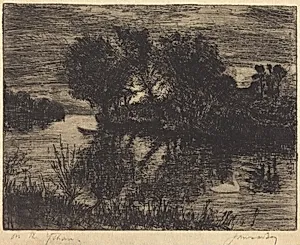
Waterton Ferry, Ellon
1905
Medium
etching
Dimensions
sheet: 13.6 × 18 cm (5 3/8 × 7 1/16 in.)
Classification
Department
CG-W
Museum
National Gallery of Art, Washington, D.C.
Credit
Rosenwald Collection
Accession Number
1943.3.5909
Rights
Public Domain
Art Historical Context
James McBey's *Waterton Ferry, Ellon (1905) captures a serene slice of Scottish rural life in this intimate etching, measuring just 13.6 × 18 cm. At age 22, the self-taught Scottish artist was honing his craft, drawing inspiration from the misty landscapes his native Aberdeenshire. Ellon, a historic village the River Ythan, provides the backdrop for depiction of the Waterton—a practical crossing point evoking everyday rhythms of early 20th-century Scotland. Etching, McBey's preferred medium shines here through its precision and atmospheric depth Using acid to bite fine lines into a metal plate, he achieved subtle tonal variations that mimic the play of light on water and distant hills, echoing influences like James McNeill Whistler and Rembrandt. This print exemplifies the etching revival of the era, where artists prized its painterly qualities for intimate, editioned works. Housed in the National Gallery of Art's Rosenwald Collection, *Waterton Ferry* highlights McBey's early mastery and enduring appeal. Visitors can appreciate how such modest scenes preserve cultural snapshots, bridging personal artistry with Scotland's pastoral heritage.
About the Artist
James McBey · 1883–1959
James McBey (1883–1959) was a Scottish artist renowned for his etchings and paintings, emerging from humble beginnings in Newburgh, Aberdeenshire, as the illegitimate son of a blacksmith's daughter. Largely self-taught, he left school at fifteen to work as a bank clerk in Aberdeen, where he devoured art books from the public library and attended evening classes at Gray's School of Art to hone his ...