
Wearing Blanket
c. 1885
Medium
Wool, wedge tapestry weave
Dimensions
With tassels: 142.3 × 203.9 cm (56 × 80 1/4 in.); Without tassels: 137.2 × 202.6 cm (54 × 79 3/4 in.)
Classification
blanket (covering)
Department
Textiles
Museum
Art Institute of Chicago
Accession Number
122876
Rights
Public Domain
About this artwork
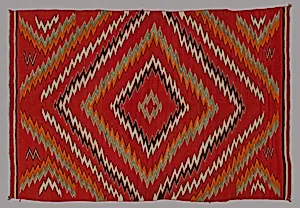
In the late 1800s, Navajo weavers developed a new, more colorful and complex style of weaving. They began incorporating wool yarns that had been dyed with vibrant commercial dyes, made available through expanded railroads. They often rendered the junctures between colors as serrated, zigzag lines, creating dynamic patterns that visually vibrate. For this reason, these textiles have come to be called “eye dazzlers.” This “eye-dazzler” weaving is part of a collection of Native American art that b...
Art Historical Context
This stunning *Wearing Blanket*, woven by Diné (Navajo) artists around 1885, exemplifies the mastery of Navajo textile traditions in the late 19th century. Measuring over 5 feet by 6 feet (with tassels), this wool blanket was designed not just for warmth but as a wearable garment—a symbol of cultural identity and status among the Navajo people. Its bold geometric patterns, likely featuring the iconic "eye-dazzler" motifs common in this era, reflect the Diné's deep connection to their landscape, spirituality, and history. Crafted using the wedge tapestry weave technique, the blanket showcases an ingenious method where weavers build patterns incrementally in wedge-shaped sections. This allows for precise, interlocking designs without floats, creating vibrant, reversible textiles prized for durability and beauty. By the 1880s, Navajo weavers had refined these skills amid profound change, including the aftermath of the Long Walk and reservation life, blending indigenous ingenuity with commercial dyes and trade influences. Housed in the Art Institute of Chicago's Textiles Department, this blanket invites visitors to appreciate how Navajo artistry transformed everyday wool into profound cultural narratives—enduring testaments to resilience and creativity.