
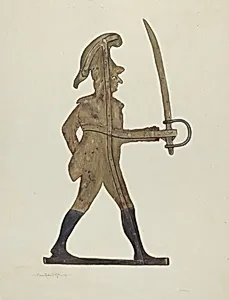
Weather Vane - Count Casimir Pulaski
c. 1940
Medium
watercolor, graphite, and pen and ink on paper
Dimensions
overall: 40.8 x 29.2 cm (16 1/16 x 11 1/2 in.) Original IAD Object: 48" high; 30" wide
Classification
Index of American Design
Department
CG-W
Museum
National Gallery of Art, Washington, D.C.
Credit
Index of American Design
Accession Number
1943.8.16684
Rights
Public Domain
Art Historical Context
Behold the intricate rendering of the *Weather Vane - Count Casimir Pulaski a captivating watercolor, graphite, and pen-and-ink drawing on paper by Elmer R.ottcamp, created around 1940. Measuring 40.8 x 29.2 cm, this work is part of the Index of American Design (IAD), a Federal Art Project of the Works Progress Administration during the Great Depression. The IAD commissioned artists to document everyday American folk art, preserving vanishing crafts through precise, colorful illustrations like this one, which captures a monumental 48-inch-high, 30-inch-wide sheet metal weather vane. The vane honors Count Casimir Pulaski, the Polish cavalry officer dubbed the "Father of American Cavalry" for his heroic role in the Revolutionary War, including the pivotal Siege of Savannah in 1779. Weather vanes like this—often crafted by local metalsmiths—served both practical and patriotic purposes, adorning barns and rooftops while celebrating national heroes. Kottcamp's detailed technique blends soft watercolor washes for depth, graphite for shading, and fine ink lines for crisp outlines, evoking the vane's dynamic form mid-swivel against a stormy sky. Housed in the National Gallery of Art's collection, this piece highlights America's folk art heritage, blending functionality with folklore. It invites us to appreciate how ordinary objects immortalized extraordinary stories of valor and ingenuity.