
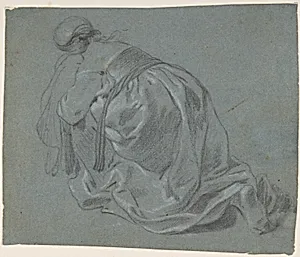
Weeping Woman Kneeling, Seen from Behind
ca. 1634–38
Medium
Black chalk, heightened with white, on blue paper
Dimensions
7 9/16 x 9 in. (19.2 x 22.8 cm)
Classification
Drawings
Department
Drawings and Prints
Museum
Metropolitan Museum of Art, New York, NY
Credit
Roger's Fund, 1953
Accession Number
53.127.3
Rights
Public Domain
Tags
Art Historical Context
In the heart of the Dutch Golden Age, Jacob Backer crafted *Weeping Woman Kneeling Seen from Behind* around 1634–38, a poignant drawing that captures raw human emotion. Backer (1608–1651), a Haarlem-born artist influenced by Rembrandt and Rubens, excelled in dramatic figure studies like this one. Rendered in black chalk heightened with white on blue paper technique known as *chiaroscuro*—the measures just 7 9/16 x 9 inches, yet conveys profound depth through subtle tonal contrasts. The blue ground enhances the luminous highlights, mimicking the play of light on fabric and skin, a hallmark of 17th-century Dutch draftsmanship prized for its preparatory power in paintings. Viewed from behind, the kneeling woman embodies sorrow, her bowed head and slumped shoulders evoking biblical or mythological grief, common motifs in Baroque art. This intimate scale suggests it was a *modello* or life study, showcasing Backer's mastery of anatomy and expression. Such drawings were highly valued in artists' studios, bridging sketches to grand canvases. Today, housed in the Metropolitan Museum of Art's Drawings and Prints department (acquired via Rogers Fund in 1953), it invites visitors to ponder the universality of mourning. Backer's sensitive touch reminds us how a simple sheet can stir the soul, bridging 17th-century Amsterdam to our own era.