
Weighing the Baby
Medium
Albumen silver print, stereo
Dimensions
Each image: 7.7 × 7.6 cm (3 1/16 × 3 in.); Card: 8.8 × 17.7 cm (3 1/2 × 7 in.)
Classification
stereograph (albumen)
Department
Photography and Media
Museum
Art Institute of Chicago
Accession Number
152547
Rights
Public Domain
Art Historical Context
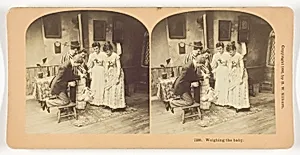
**Weighing the Baby** (1892) by Benjamin West Kilburn captures tender, everyday moment through the innovative medium of albumen silver print stereograph. Produced as a pair of nearly identical images mounted on a card—each measuring just 7.7 × 7.6 cm—these views were designed for viewing through a stereoscope, a striking three-dimensional effect. Albumen prints, made with egg whites to bind light-sensitive silver salts, were the gold standard of 19th-century photography, prized for their rich tonal range and fine detail on small scales. Kilburn, a prolific American photographer from the Kilburn Brothers studio in New Hampshire, specialized in stereographs that brought distant scenes and intimate vignettes into Victorian parlors. By 1892, at the height of stereograph mania—over seven million sold annually in the U.S.—this image reflected the era's fascination with domestic life, health practices, and family rituals. Weighing a baby evoked themes of growth, care, and community, often in rural or small-town settings, making the personal feel universally relatable. Held in the Art Institute of Chicago's Photography and Media Department, this work exemplifies how stereographs democratized photography, turning ordinary moments into immersive art. Visitors can imagine peering through a stereoscope, the baby’s form popping vividly to life, bridging 19th-century technology with timeless human stories. (198 words)