
Weight in the Shape of Liubo Game Player
Unknown Artist
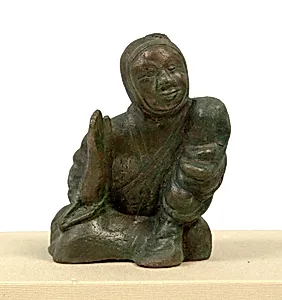
Medium
Bronze with lead core
Dimensions
H. 3 5/8 in. (9.2 cm); W. 3 in. (7.6 cm); D. 2 1/2 in. (6.4 cm)
Classification
Metalwork
Culture & Period
China · Han dynasty (206 B.C.–A.D. 220)
Department
Asian Art
Museum
Metropolitan Museum of Art, New York, NY
Credit
Purchase, Bequest of Dorothy Graham Bennett, 2003
Accession Number
2003.522.2
Rights
Public Domain
Tags
Art Historical Context
This charming bronze weight, shaped as a Liubo game player hails from China's Han dynasty (206 B.–A.D. 220), a golden era of imperial unity, cultural flourishing, and economic expansion along the Silk Road. Crafted as a practical tool for balance scales—evident from its lead core ensuring precise heft—the figurine captures a moment of everyday leisure. Standing just 3⅝ inches tall, it reflects the Han standardization of weights and measures, for fair trade in bustling markets. Liubo, an ancient board game of strategy involving dice and stones on a hexagonal board, was wildly popular during the Han, often depicted in tomb art symbolizing harmony and diversion in the afterlife. The unknown artisan masterfully cast this lively figure in bronze, showcasing advanced lost-wax techniques that allowed for intricate details: the player's dynamic pose, flowing robes, and focused expression evoke the thrill of play. As a rare survivor of utilitarian metalwork, this piece bridges art and daily life, highlighting the Han blend of functionality and whimsy. On view in the Metropolitan Museum of Art's Asian Art department, it invites us to ponder ancient pastimes not so different from our own.