
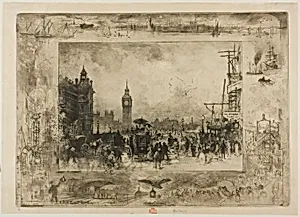
Westminster Clock Tower
Medium
Etching, drypoint, roulette, aquatint, and spit-bite on ivory Japanese paper
Dimensions
Plate: 28.4 × 39.6 cm (11 3/16 × 15 5/8 in.); Sheet: 31 × 43.2 cm (12 1/4 × 17 1/16 in.)
Classification
etching
Department
Prints and Drawings
Museum
Art Institute of Chicago
Accession Number
94996
Rights
Public Domain
Art Historical Context
Step into the atmospheric haze of Victorian London with Félix Hilaireot's *Westminster Clock Tower* (1884), a etching housed in the Art Institute of's Prints and Drawings collection. The French printmaker, active during the late 19th-century etching, captures the iconic silhouette of the Palace of Westminster's clock tower—home to Big Ben—against a moody Thames-side sky. Buhot, influenced by Impressionism's emphasis on light and mood, transforms a British landmark into a poetic evocation of time, fog, and urban grandeur. This print showcases Buhot's technical bravura through a rare combination of intaglio methods: precise etching for lines, drypoint for velvety burrs, roulette for textured tones, aquatint for subtle gradations, and spit-bite—a daring technique using saliva to soften acid bites—for ethereal edges. Printed on luxurious ivory Japanese paper, which enhances ink absorption and richness, the 28.4 × 39.6 cm plate yields a luminous, painterly effect rare in printmaking. Created amid Anglo-French cultural exchanges, the work reflects Buhot's travels and fascination with London's industrial might, bridging national artistic traditions. Its intricate layers invite visitors to linger, appreciating how 19th-century innovation turned paper into a window on history.