
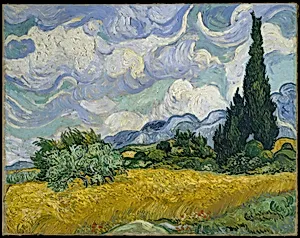
Wheat Field with Cypresses
Vincent van Gogh, June 1889
About this artwork
Vincent van Gogh painted *Wheat Field with Cypresses* in June 1889 while residing at the Saint-Paul-de-Mausole asylum in Saint-Rémy-de-Provence, France. Created en plein air as the first in his Saint-Rémy series focused on cypress trees, it captures a vibrant Provençal landscape: a golden wheat field dotted with red poppies in the foreground, towering cypresses piercing a swirling sky of billowing clouds, and the blue-gray Alpilles mountains beyond. Van Gogh himself called it one of his best summer landscapes, describing it in a letter to his brother Theo as "cypresses with some ears of wheat, some poppies, a blue sky like a piece of Scotch plaid." He later made two studio versions. This oil on canvas exemplifies Van Gogh's mature Post-Impressionist style, with thick impasto layers, vibrant unmixed colors, and energetic, swirling brushstrokes that infuse the scene with rhythmic movement and emotional intensity. The cypresses, which he saw as symbols of life's eternal cycles and even death, dominate the composition, while his approach to simplifying nature into geometric forms foreshadowed Cubism and abstract art. At 28⅞ × 36¾ inches, this masterwork at the Metropolitan Museum of Art reveals Van Gogh's profound ability to transform everyday landscapes into spiritually resonant visions, bridging personal turmoil with universal beauty.