
Wheat Field with Cypresses
June 1889
Medium
Oil on canvas
Dimensions
28 7/8 × 36 3/4 in. (73.2 × 93.4 cm)
Classification
Paintings
Department
European Paintings
Museum
Metropolitan Museum of Art, New York, NY
Credit
Purchase, The Annenberg Foundation Gift, 1993
Accession Number
1993.132
Tags
About this artwork
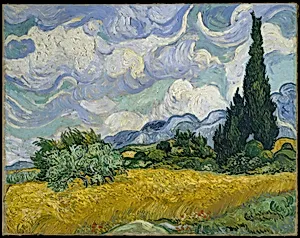
Wheat Field with Cypresses is an oil painting by Dutch Post-Impressionist Vincent van Gogh, created in June 1889 during his stay at the Saint-Paul-de-Mausole asylum in Saint-Rémy-de-Provence, France. Van Gogh regarded this work as one of his best summer landscapes. The painting depicts a dynamic landscape dominated by towering cypress trees against a swirling sky with billowing clouds. A golden wheat field occupies the foreground, dotted with red poppies, while the Alpilles mountains form a blu...
Art Historical Context
Vincent van Gogh painted *Wheat Field with Cypresses* in June 1889 while residing at the Saint-Paul-de-Mausole asylum in Saint-Rémy-de-Provence, France. Created en plein air as the first in his Saint-Rémy series focused on cypress trees, it captures a vibrant Provençal landscape: a golden wheat field dotted with red poppies in the foreground, towering cypresses piercing a swirling sky of billowing clouds, and the blue-gray Alpilles mountains beyond. Van Gogh himself called it one of his best summer landscapes, describing it in a letter to his brother Theo as "cypresses with some ears of wheat,...
About the Artist
Vincent van Gogh · 1853–1890
Vincent Willem van Gogh (1853-1890) stands as one of the most influential figures in Western art history, despite a career spanning merely a decade. Born in Groot-Zundert, Netherlands, to a Protestant pastor's family, van Gogh's path to artistic greatness was anything but conventional. His early adulthood saw him working as an art dealer for Goupil & Cie, a language teacher, and a fervent missiona...