
Wheel barometer
ca. 1841–45
Medium
Mahogany, brass, paper, barometric mechanism, and various other materials
Dimensions
42 × 12 1/4 in. (106.7 × 31.1 cm)
Classification
Wheel barometer
Culture
American
Department
The American Wing
Museum
Metropolitan Museum of Art, New York, NY
Credit
Gift of Mr. and Mrs. Stuart P. Feld, 2013
Accession Number
2013.960.3
Rights
Public Domain
Art Historical Context
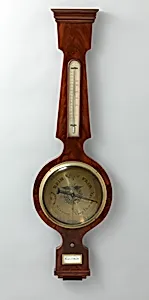
This elegant wheel barometer, crafted by Louis A. Smith around 1841–45, exemplifies the American tradition of blending scientific instruments with fine furniture making. Housed in the Metropolitan Museum’s American Wing, the piece reflects the mid-nineteenth-century fascination with meteorology among educated households. Barometers of this period served not only as practical tools for predicting weather changes but also as refined decorative objects that signaled a family’s interest in both science and domestic elegance. Smith’s design combines rich mahogany casing with brass accents and a paper dial, showcasing the skilled integration of woodworking, metalwork, and precision mechanics. The vertical form, measuring over three feet tall, would have been prominently displayed in a parlor or study, where its large, easy-to-read dial allowed viewers to track atmospheric pressure at a glance. Such instruments were often collaborative efforts, with cabinetmakers like Smith working alongside makers of the internal barometric mechanisms. As a gift to the museum from Mr. and Mrs. Stuart P. Feld, this barometer highlights how everyday scientific devices became cherished expressions of American craftsmanship during the antebellum era. Its survival offers visitors a tangible connection to a time when understanding the natural world was both a practical necessity and a mark of cultural refinement.