
Whipping Post
1935/1942
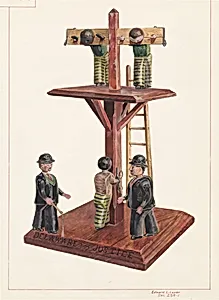
Medium
watercolor, graphite, and colored pencil on paper
Dimensions
overall: 39.2 x 30.2 cm (15 7/16 x 11 7/8 in.)
Classification
Index of American Design
Department
CG-W
Museum
National Gallery of Art, Washington, D.C.
Credit
Index of American Design
Accession Number
1943.8.10191
Rights
Public Domain
Art Historical Context
**Whipping Post** by Edward L. L, created between 1935 and1942, captures a symbol of colonial American justice in watercolor, graphite, and colored on paper (39.2 x 30.2 cm). This mixed-media rendering belongs to the *Index of American Design*, ambitious WPA Federal Art Project that employed artists during the Great Depression to document the nation's folk art, crafts, and everyday objects. Loper's precise technique—blending fluid watercolors for texture, graphite for fine lines, and colored pencil for subtle highlights—brings historical artifacts to life with documentary accuracy, preserving details that might otherwise fade. The whipping post itself evokes the harsh public punishments of 17th- and 18th-century America, where stocks and posts served as tools of social control in town squares from New England to the South. By rendering this utilitarian yet chilling object, Loper highlights a pivotal chapter in U.S. cultural history, underscoring themes of discipline, community, and evolving justice systems. Housed in the National Gallery of Art's CG-W department, this work reflects the Index's mission to celebrate American ingenuity amid economic hardship, offering visitors a window into our shared, sometimes somber, heritage. (198 words)
About the Artist
Edward L. Loper · 1916–2011
Edward Leroy Loper Sr. was born on April 7, 1916, in Wilmington, Delaware, to a poor family in the racially mixed Frogtown neighborhood, where he was raised primarily by his maternal grandmother. After graduating from Howard High School, the only secondary school available to African Americans in Delaware at the time, Loper received no formal artistic training initially but immersed himself in sel...