
Whistle
Unknown Artist
19th century
Medium
Wood
Dimensions
Height: 19 5/16 in. (49.1 cm) Width: 5 7/8 in. (15 cm)
Classification
Aerophone-Whistle Flute-whistle
Culture
Mossi or Guronsi People
Department
Musical Instruments
Museum
Metropolitan Museum of Art, New York, NY
Credit
Purchase, Gifts of June Fenton and Mr. and Mrs. Peter M. F. Sichel, by exchange, 1982
Accession Number
1982.89.1
Rights
Public Domain
Tags
Art Historical Context
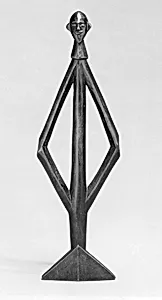
This intricately carved wooden whistle, dating to the 19th, hails from the Mossi or Gurunsi of Burkina Faso in West Africa. Standing at 19 5/16 inches tall and 5 7/8 inches wide, exemplifies the skilled woodworking traditions of these cultures, where instruments like this aerophone—classified as a whistle flute—were crafted from local woods and often featured anthropomorphic elements, such as stylized heads, evoking human or spiritual forms. In Mossi and Gurunsi societies, such whistles played vital roles in rituals, ceremonies, and daily life, producing shrill tones to signal events, accompany dances, or invoke ancestral spirits. The medium of wood allowed artisans to employ subtractive carving techniques, revealing expressive details that blend functionality with artistry. This piece highlights the cultural importance of music in West African traditions, where instruments served as bridges between the physical and metaphysical worlds. Acquired by the Metropolitan Museum of Art in 1982 through a generous exchange, this whistle offers visitors a tangible connection to 19th-century African ingenuity, inviting reflection on how sound and sculpture intertwined in communal expression.