
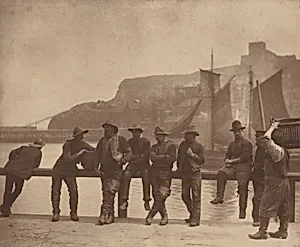
Whitby Fishermen
c. 1885
Medium
carbon print
Dimensions
image: 24.4 x 29.3 cm (9 5/8 x 11 9/16 in.) sheet: 25 x 30 cm (9 13/16 x 11 13/16 in.)
Classification
Photograph
Department
CPH
Museum
National Gallery of Art, Washington, D.C.
Credit
Robert B. Menschel Fund
Accession Number
1999.57.2
Rights
Public Domain
Art Historical Context
Frank Meadow Sutcliffe's *Whitby Fishermen*c. 1885) captures the rugged essence of life in the coastal town of Whitby, Yorkshire England—a historic fishing hub on the North Sea. Sutcliffe, a pioneering British photographer born in 1853, much of his career to documenting daily labors of local fishermen, portraying them not as quaint subjects but as resilient figures emblematic of Victorian working-class endurance. This carbon print, measuring about 24.4 x 29.3 cm, evokes the maritime environment through its evocative composition, likely highlighting weathered faces, coiled ropes, and the sea's unforgiving backdrop. The carbon print medium, a hallmark of 19th-century photography, underscores Sutcliffe's technical mastery. Invented in the 1850s, it uses pigmented gelatin to produce images with exceptional permanence and rich tonal depth—resistant to fading, unlike earlier processes. Sutcliffe favored it for its subtle gradations, aligning with the emerging Pictorialist movement's emphasis on photography as fine art, blending realism with artistic atmosphere. Housed in the National Gallery of Art's photography collection (thanks to the Robert B. Menschel Fund), this work highlights Sutcliffe's legacy as Whitby's unofficial chronicler. His images romanticized yet humanized industrial-era toil, influencing later documentary photographers and preserving a vanishing seafaring culture for generations. A poignant window into 1880s Britain, it invites visitors to ponder the fishermen's quiet heroism.