
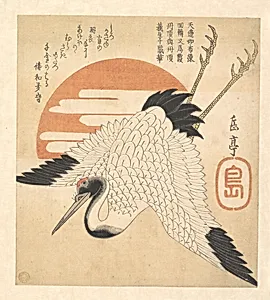
White Crane Flying across the Sun's Disc
1835?
Medium
Woodblock print (surimono); ink and color on paper
Dimensions
7 7/8 x 7 in. (20 x 17.8 cm)
Classification
Prints
Culture & Period
Japan · Edo period (1615–1868)
Department
Asian Art
Museum
Metropolitan Museum of Art, New York, NY
Credit
Gift of Estate of Samuel Isham, 1914
Accession Number
JP1039
Rights
Public Domain
Tags
Art Historical Context
Behold the graceful *White Crane Flying across the's Disc*, a delicate woodblock print (surono) created by Y Gakutei around 1835 during Japan's Edo period (1615–1868). This intimate square-format work, measuring just 7 7/8 x 7 inches, exemplifies surimono—luxury prints commissioned for private audiences, often featuring poetry and refined craftsmanship. Gakutei, a master of ukiyo-e traditions, captures a fleeting moment of natural poetry: a majestic white crane soaring boldly across the radiant sun's disc, rendered in vibrant inks and colors on paper. Cranes hold profound cultural significance in Japan as emblems of longevity, good fortune, and marital fidelity, their elegant forms often celebrated in art to invoke wishes for prosperity. The sun, a potent symbol of vitality and imperial power, adds a layer of cosmic harmony to the composition. Gakutei's precise woodblock technique highlights subtle gradations and bold contrasts, showcasing the era's innovative printing methods that brought ephemeral beauty to elite collectors. Now at the Metropolitan Museum of Art, gifted from the Estate of Samuel Isham in 1914, this print invites visitors to ponder the Edo world's reverence for nature's splendor—a timeless reminder of art's power to elevate the everyday into the eternal.
About the Artist
Yashima Gakutei · 1786–1868
Yashima Gakutei (c. 1786–1868), born in Osaka as the illegitimate son of a Tokugawa shogunate samurai named Hirata, adopted the name from his mother's subsequent marriage into the Yashima clan. Little is documented about his early years beyond these familial ties, but he pursued artistic training under the esteemed ukiyo-e masters Totoya Hokkei and Katsushika Hokusai, absorbing their precision in ...