
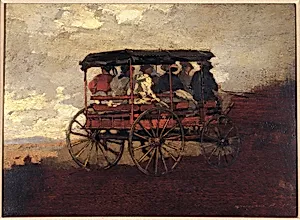
White Mountain Wagon
Medium
landscapes
Classification
landscapes
Department
Smithsonian Collection
Museum
Smithsonian American Art Museum
Credit
Gift of Mrs. Charles Savage Homer, Jr.
Accession Number
1918-20-9
Rights
Public Domain
About this artwork
Horizontal view of a three-bench wagon carrying seven passengers along a ridge in foreground, overlooking distant mountains and sky with clouds in the background. Verso: mountain landscape with house in middle distance.
Art Historical Context
**White Mountain Wagon, Winslow Homer (1868–69)** Step into the rugged beauty of post-Civil War America with Homer's *White Mountain*, a captivating landscape watercolor from the Smithsonian American Art. Painted during Homer's 1868 visit to New Hampshire's White Mountains—a hotspot for emerging tourism—this horizontal composition places a sturdy three-bench wagon with seven passengers along a foreground ridge. They gaze out over hazy distant peaks under a vast, cloud-streaked sky, evoking the thrill of 19th-century travel and the awe of untamed nature. Homer, a master of American Realism, captured everyday life with unflinching honesty, transitioning from Civil War illustrations to luminous outdoor scenes. Here, his precise brushwork highlights atmospheric depth and the interplay of light on mountains, blending human activity with wilderness grandeur. The verso reveals another mountain landscape with a house in the middle distance, showcasing Homer's efficient use of both sides of the paper—a practical technique in his prolific watercolor phase. This gift to the Smithsonian from Mrs. Charles Savage Homer, Jr., reminds us of the era's growing appreciation for national scenery, symbolizing America's healing and expansion westward. A perfect snapshot of leisure amid majesty! (198 words)