
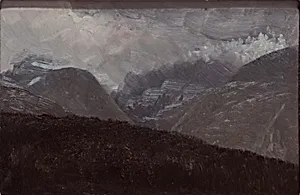
White Mountains, New Hampshire
Classification
Painting
Department
Smithsonian Collection
Museum
Smithsonian American Art Museum
Credit
Hirshhorn Museum and Sculpture Garden, Smithsonian Institution, Washington, DC, Gift of Joseph H. Hirshhorn, 1966
Accession Number
66.502
Rights
Public Domain
About this artwork
Florence Lewison Gallery, New York, to 1963
Art Historical Context
Albert Bierstadt’s *White Mountains, New Hampshire* captures the serene majesty of the American Northeast in 1857, a time when artists were helping shape a national identity through the celebration of native landscapes. Born in Germany and raised in the United States, Bierstadt became a leading figure of the Hudson River School, known for his luminous depictions of untamed wilderness that blended precise observation with romantic grandeur. This early work, created before his celebrated journeys west, reveals his growing fascination with light and atmosphere in the rugged terrain of New England. Paintings like this one played an important role in 19th-century America by inviting viewers to see the natural world as both beautiful and symbolic of the young nation’s promise. Bierstadt’s careful attention to rocky peaks and expansive skies encourages a sense of awe and discovery, qualities that would define his later, more dramatic canvases. Today the work resides in the Smithsonian American Art Museum, a gift that continues to connect audiences with the enduring appeal of American landscape painting. The painting’s journey through the Florence Lewison Gallery in New York before entering the Hirshhorn Museum’s collection underscores its lasting value to scholars and collectors alike.