
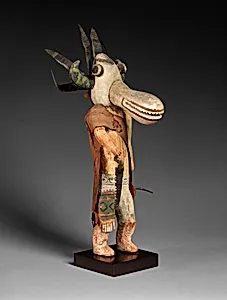
White Ogre Tihu (Katsina Figure)
Unknown Artist
ca. 1900
Medium
Cottonwood, pigment, cotton cloth, tanned leather, and metal
Dimensions
H. 18 1/2 × W. 6 × D. 7 in. (47 × 15.2 × 17.8 cm)
Classification
Katsina Figure
Culture
Hopi, Native American
Department
The American Wing
Museum
Metropolitan Museum of Art, New York, NY
Credit
The Charles and Valerie Diker Collection of Native American Art, Gift of Charles and Valerie Diker, 2021
Accession Number
2021.434.12
Rights
Public Domain
Art Historical Context
This striking sculpture presents a standing figure carved from cottonwood, its elongated white head featuring a long snout, bared teeth, and large round eyes that gaze forward. Dark, blade-like horns or feathers project from the crown, while traces of pigment and a weathered surface suggest years of handling. The body is clad in a draped brown cloth garment secured with tanned leather, revealing painted geometric patterns in muted greens and whites along the lower torso and legs. Metal elements and cotton accents complete the figure, which stands about eighteen inches tall on its modern base. Known as a White Ogre Tihu, or Katsina figure, this work was created around 1900 by an unknown Hopi artist. In Hopi tradition, such tihu serve as both devotional objects and teaching tools, helping children recognize the katsinam—spirit beings who bring rain, fertility, and moral guidance during ceremonies. The White Ogre represents one of many distinct katsina personalities, its fierce appearance intended to convey lessons about discipline and community values. Today this tihu belongs to The Metropolitan Museum of Art’s American Wing as part of the Charles and Valerie Diker Collection, offering visitors a tangible connection to Hopi cultural heritage from the early twentieth century.