
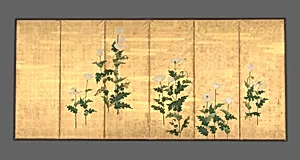
White Poppies on Gold Ground
Medium
Six-panel folding screen; color on paper
Dimensions
67 in. × 12 ft. 7 in. (170.2 × 383.5 cm)
Classification
Paintings
Culture & Period
Japan · Edo period (1615–1868)
Department
Asian Art
Museum
Metropolitan Museum of Art, New York, NY
Credit
H. O. Havemeyer Collection, Gift of Horace Havemeyer, 1949
Accession Number
49.35.1
Rights
Public Domain
Tags
Art Historical Context
Ogata Kōrin's *White Poppies on Ground* is a masterful six-panel folding screen from Edo period (1615–1868), a time of relative peace and prosperity that fostered lavish decorative arts for elite homes and tea houses. Created with vibrant colors on paper, this exemplifies Kōrin's affiliation with the Rinpa school known for its bold, stylized depictions of nature. The luminous gold ground evokes opulence, mimicking sheets of gold leaf traditionally used to symbolize purity and the divine, while the delicate white poppies—rare in Japanese flora—float asymmetrically across the panels, creating a sense of ethereal movement. Kōrin's technique shines in his rhythmic brushwork and flattened perspective, where flowers overlap in harmonious clusters rather than realistic depth, prioritizing decorative beauty over naturalism. This approach influenced generations of artists, blending literati elegance with merchant-class extravagance. Folding screens like this *byōbu* were not mere decorations but functional room dividers, transforming interiors into immersive gardens. Housed in the Metropolitan Museum of Art's Asian Art collection, gifted from the H.O. Havemeyer Collection in 1949, *White Poppies* invites viewers to appreciate Edo Japan's fusion of artistry and luxury— a blooming testament to fleeting beauty.
About the Artist
Ogata Kōrin · 1658–1716
Noted as one of the most important Japanese artists of the 17th century; known for paintings of irises and other subjects. He was regarded, along with Sotatsu, as one of the masters of the Sotatsu-Koetsu school of decorative painting, including painted screens and textile designs. He was descended from a samurai who had served under the Ashikaga rulers.