
Whorl
Unknown Artist
7th century BCE
Medium
Amber
Dimensions
Diameter: 1 13/16 x 5/8 in. (4.6 x 1.6 cm)
Classification
Miscellaneous-Amber
Culture & Period
Etruscan or Italic · Late Geometric
Department
Greek and Roman Art
Museum
Metropolitan Museum of Art, New York, NY
Credit
Purchase, 1896
Accession Number
96.9.482
Rights
Public Domain
Art Historical Context
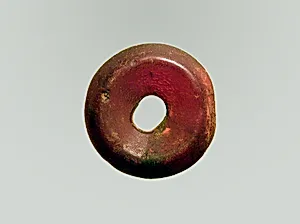
Behold the delicate "Whorl," a small yet captivating artifact from the 7th century BCE, crafted by an unknown artist in the Late Geometric period. Hailing from Etruscan or Italic culture this amber object—measuring just 1 13/16 x 5/8 inches (4.6 x 1.6 cm)—exemplifies the everyday artistry of pre-Roman Italy. Likely a spindle whorl used for spinning wool or linen thread, it reflects the practical ingenuity of ancient households, where even utilitarian tools blended form and function. Amber, sourced from Baltic shores and traded across the Mediterranean, held immense value in antiquity for its warm, golden glow and believed protective properties. Carved smoothly into a disc shape, this piece showcases the material's natural translucency and the skill required to work its soft, resinous form without cracking. In Etruscan society, renowned for their metalwork and textiles, such objects underscore a thriving domestic economy and cultural exchange with Greek influences evident in the Geometric era's precise, abstract aesthetics. Acquired by the Metropolitan Museum of Art through purchase in 1896, this whorl invites us to ponder the unseen hands that spun the fabrics of history. A testament to ancient craftsmanship, it bridges the worlds of utility and beauty in the Greek and Roman Art collection.