
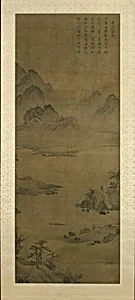
모래밭에 내려앉는 기러기 조선|平沙落雁圖 朝鮮|Wild geese descending to sandbar
late 15th–early 16th century
Medium
Hanging scroll; ink on silk
Dimensions
Image: 49 3/4 × 19 1/4 in. (126.4 × 48.9 cm) Overall with mounting: 91 3/4 × 24 1/2 in. (233 × 62.2 cm) Overall with knobs: 91 3/4 × 27 1/4 in. (233 × 69.2 cm)
Classification
Paintings
Culture & Period
Korea · Joseon dynasty (1392–1910)
Department
Asian Art
Museum
Metropolitan Museum of Art, New York, NY
Credit
Purchase, Harris Brisbane Dick Fund, John M. Crawford Jr. Bequest, and The Vincent Astor Foundation Gift, 1992
Accession Number
1992.337
Rights
Public Domain
Tags
Art Historical Context
This evocative hanging scroll, created by an unidentified Korean artist during the late 15th to early 16th century, captures the poetic theme of wild geese descending onto a sandbar. Executed in ink on silk during the early Joseon dynasty, the vertical composition highlights Korea’s rich tradition of landscape painting, where natural scenes often conveyed themes of harmony, transience, and seasonal change. The delicate medium allows for subtle ink washes and fine brushwork that suggest mist-shrouded mountains and flowing rivers, inviting viewers to pause and reflect on nature’s quiet rhythms. Such “geese descending” motifs belong to a long East Asian artistic lineage inspired by the classic Eight Views of the Xiao and Xiang Rivers, which Korean painters adapted to express Confucian ideals of balance and scholarly retreat. Though the artist remains unknown, the work reflects the period’s emphasis on ink landscapes as vehicles for contemplation rather than mere decoration. Displayed as a hanging scroll, it would originally have been viewed in a scholar’s studio or temple setting, unrolled to reveal its full height and then stored away. Today at The Metropolitan Museum of Art, the painting offers visitors a serene window into Joseon-era aesthetics, where mountains, rivers, and migrating birds together evoke both the beauty of the Korean peninsula and the philosophical depth of its artistic heritage.