
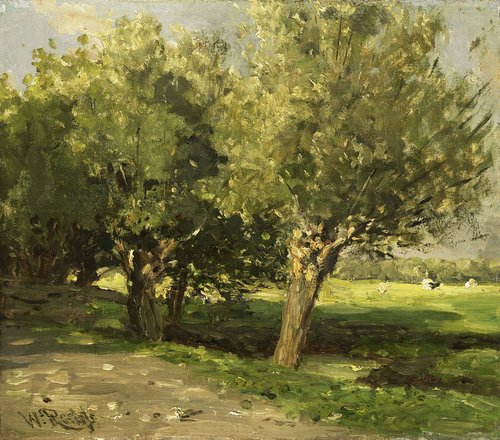
Wilgebomen
1875 - 1885
Medium
oil on canvas on panel
Dimensions
30.1; 34.2; 1; 8
Rights
Public Domain
About this artwork
…; on loan from Jean Charles Joseph Drucker (1862-1944, Montreux) and Maria Lydia Drucker-Fraser (1886-1944, Montreux), with 70 other paintings, to the museum, 1919;{Note RMA.} by whom bequeathed, with 71 other paintings, to the museum, 1944
Art Historical Context
**Wilgebomen (Willow Trees)** *Willem Roelofs (I), 1875–1885* *Oil on canvas on panel, 30.1 × 34.2 cm* *Rijksmuseum, Amsterdam* Willem Roelofs (1822–1897), a prominent Dutch artist of the 19th century, captures the serene beauty of nature in *Wilgebomen*, a small-scale oil painting depicting graceful willow trees. Created between 1875 and 1885, during the artist's mature years, this work reflects the Dutch tradition of intimate landscape studies. The modest dimensions—about the size of a large book—invite close contemplation, evoking the quiet waterways and lush foliage typical of the Low Countries. Roelofs, often linked to the Hague School's realistic approach to outdoor scenes, employed oil on canvas stretched over a sturdy panel, a technique favored for its stability and fine detail in smaller formats. This support allowed precise brushwork to render the willows' delicate branches and textured bark, highlighting light's play on natural forms. Such paintings celebrated the everyday poetry of the Dutch countryside, bridging Romanticism and emerging Impressionism. Acquired on loan in 1919 from collectors Jean Charles Joseph Drucker and Maria Lydia Drucker-Fraser, the artwork was bequeathed to the Rijksmuseum in 1944 alongside 71 others from their esteemed collection. This generous legacy preserves Roelofs's vision for future generations, underscoring the cultural value of private patronage in enriching public heritage.