
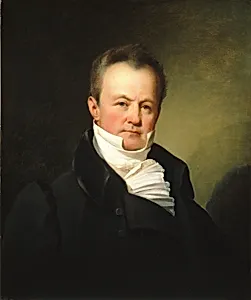
William Clark Frazer
c. 1830
Medium
oil on canvas
Dimensions
overall: 76.2 x 63.5 cm (30 x 25 in.) framed: 85.7 x 98.4 x 7.3 cm (33 3/4 x 38 3/4 x 2 7/8 in.)
Classification
Painting
Department
CAB
Museum
National Gallery of Art, Washington, D.C.
Credit
Andrew W. Mellon Collection
Accession Number
1947.17.3
Rights
Public Domain
Art Historical Context
**William Clark Frazer** is a compelling portrait by Jacob Eichholtz, a self-taught Pennsylvania artist active in the early 19th century. around 1830, this oil-on-canvas work captures the likeness of its namesake subject, likely a figure of local prominence in the burgeoning American republic. Eichholtz, born into a Pennsylvania German family, rose from tinsmith to itinerant portraitist, embodying the folk art tradition that democratized fine art for the middle class. At 76.2 x 63.5 cm, the intimately scaled canvas invites viewers into a personal encounter, framed elegantly to 85.7 x 98.4 x 7.3 cm for display. Eichholtz's technique reflects his untrained yet earnest style: bold outlines, flattened modeling, and vivid colors create a direct, unflinching gaze typical of early American folk portraiture. Oil on canvas allowed for rich textures and luminous skin tones, signifying status and permanence in an era when photography was decades away. Props or attire—common in Eichholtz's oeuvre—would subtly denote the sitter's profession or achievements, underscoring portraiture's role in self-fashioning. Housed in the National Gallery of Art's Andrew W. Mellon Collection (Department: CAB), this painting highlights the artistic vitality of antebellum America. It preserves a slice of everyday history, reminding us how folk artists like Eichholtz bridged European traditions and American identity, making high art accessible to all.
About the Artist
Jacob Eichholtz · 1776–1842
Comment on works: portraits