
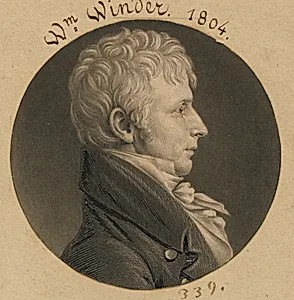
William Henry Winder
Medium
Classification
Department
Smithsonian Collection
Museum
Smithsonian American Art Museum
Credit
National Portrait Gallery, Smithsonian Institution; gift of Mr. and Mrs. Paul Mellon
Accession Number
S/NPG.74.39.8.10
Rights
Public Domain
Tags
Art Historical Context
Discover the elegant profile portrait of **William Henry Winder**, created in 1804 by French-born artist Charles Balthazar Févret de Saintémin. This print captures Winder, a prominent Maryland lawyer and future military leader, in the refined silhouette style that made Saint-Mémin famous Arriving in America as a refugee from the French Revolution, Saint-Mémin pioneered a mechanical tracing device called the physiognotrace to produce precise, cameo-like profiles, which he then hand-colored and engraved. These affordable prints became a sensation among early American elites, blending European sophistication with democratic accessibility. Rendered as a delicate print, the artwork exemplifies Saint-Mémin's innovative technique, emphasizing outline and subtle shading over full realism. Housed in the Smithsonian American Art Museum's National Portrait Gallery (gift of Mr. and Mrs. Paul Mellon), it reflects the neoclassical taste of the early republic, where profile portraits evoked ancient Roman coins. Winder's legacy gained prominence during the War of 1812, where he served as a brigadier general, commanding U.S. forces in key battles. Created two decades earlier, this portrait offers a poignant glimpse into his pre-war life, bridging personal identity with national history. A testament to early American portraiture, it invites visitors to ponder how one image can encapsulate ambition and destiny.